Walk into any airport bookstore and you’ll find an entire wall devoted to leadership books. Browse LinkedIn and you’ll see countless posts sharing “leadership wisdom” from successful CEOs. Attend any business conference and you’ll hear inspiring stories about transformational leaders who changed everything through vision and authenticity.
Here’s the uncomfortable truth: most of this advice is not just useless—it’s actively harmful to your career and effectiveness as a leader.
Many books on leadership are like fairy tales: inspiring, but misleading about leadership that is actually effective in our real world. Real leadership—based on evidence and science, and thus statistically more likely to be effective in practice—is less commonly found in leadership teachings. Instead, what we often hear is “feel good leadership” that sounds good, but is often ineffective, or worse, counterproductive.
The problem isn’t that successful leaders are lying to us (though some are). The deeper issue is that the stories we tell about leadership success systematically distort how leadership actually works. When we mistake correlation for causation, survivor bias for universal truth, and post-hoc rationalization for strategic insight, we end up with advice that sounds profound but fails in practice.
Why Leadership Advice Fails: The Five Fatal Flaws
Understanding why most leadership advice fails requires examining the fundamental flaws in how we study and teach leadership. These aren’t minor methodological issues—they’re systematic problems that corrupt nearly everything we think we know about effective leadership.
1. Lack of Rigor: The Survivor Bias Problem
Most leadership lessons are based on someone’s experience without systematic analysis of complete data, comprehensive understanding of circumstances, and other available options at the time. What worked for the winner may be simply chance (luck), weakness of the opposition, or insufficiently acknowledged help from others.
Consider how we study business success. When a company thrives, we interview the CEO and analyze their leadership style. When companies fail, we largely ignore them or briefly mention their failures as cautionary tales. This creates a massive survivor bias—we’re studying only the winners and assuming their approaches caused their success.
Think about the dot-com boom of the late 1990s. Countless entrepreneurs were hailed as visionary leaders for making bold bets on internet businesses. The vast majority of these “visionaries” lost everything when the bubble burst in 2000. The few who succeeded often benefited from timing, luck, or market dynamics that had little to do with their leadership approach. Yet the business press focused almost exclusively on the winners, creating the impression that their specific leadership styles were the key to success.
The same pattern repeats everywhere. We celebrate Steve Jobs’ demanding perfectionism while ignoring the hundreds of equally demanding leaders whose companies failed. We praise Southwest Airlines’ culture of fun while overlooking other companies that tried similar approaches and struggled. We’re essentially studying lottery winners and then teaching people that their number-picking strategies are the key to wealth.
2. Before and After: The Success Transformation Myth
The behaviors that lead a person to a powerful leadership position are often not the same as the good qualities the person assumes later in life after they are already successful. Take the case of Bill Gates, who as a competitive businessman was a different person from the kind, caring philanthropist he is today.
This transformation phenomenon is more common than we acknowledge. The traits that help someone climb to power—ruthless competition, single-minded focus, willingness to make difficult personnel decisions—are often quite different from the traits they exhibit once they’ve achieved success and security.
Consider Michael Bloomberg’s evolution. As a Wall Street trader and then as the founder of Bloomberg LP, he was known for his intense, sometimes abrasive style. He pushed employees hard, made quick decisions without extensive consultation, and focused relentlessly on results. Yet when business schools study his leadership, they often emphasize his later qualities as mayor of New York—his data-driven approach to governance, his collaborative work with city council, his thoughtful public statements.
This creates a dangerous misconception. Young leaders read about Bloomberg’s collaborative leadership style and try to emulate it, not realizing that his collaborative approach worked because he was already established, wealthy, and secure. Someone trying to build their career using only the collaborative approach might find themselves outmaneuvered by competitors who understand that different situations require different leadership styles.
The lesson isn’t that successful leaders are hypocrites—it’s that effective leadership is contextual. The behaviors that help you gain power are often different from the behaviors that help you use power wisely. Most leadership advice fails to make this crucial distinction.
3. Delusion: The Self-Perception Gap
Human beings have positive impressions of ourselves that are often not accurate. Studies have shown that about 80% of people believe they are better car drivers than average, better looking than average, and better human beings than others. The overconfidence effect and above-average effect are well documented. How a successful leader feels they act (morally) is often quite different from what they actually do based on observation.
This self-perception gap becomes particularly problematic when successful leaders write memoirs or give interviews about their leadership approach. They genuinely believe their own stories about being collaborative, ethical, and people-focused, even when objective evidence suggests a more complex reality.
Take the common claim that successful leaders “put people first.” When researchers actually study leadership behavior—looking at how leaders spend their time, what they prioritize in meetings, and how they make difficult decisions—they often find a significant gap between stated values and actual behavior. A CEO might genuinely believe they put people first because they remember the times they made people-focused decisions, while unconsciously forgetting the many times they prioritized profits, efficiency, or competitive advantage over employee welfare.
This isn’t conscious deception—it’s how human memory and self-perception work. We tend to remember our best moments and forget our worst ones. We interpret our actions in the most favorable light and assume our motivations were pure. When these naturally distorted self-perceptions become the basis for leadership advice, the advice becomes dangerously unrealistic.
The practical implication is significant: you cannot rely on successful leaders’ self-reports about their behavior. If you want to understand how leadership actually works, you need to look at what leaders do, not just what they say they do.
4. Deception: The Competitive Advantage Secret
Human beings, especially successful ones, lie, mislead, and often don’t give away their coveted secrets that give them their competitive edge. There is plenty of scientific evidence that lying is a common daily habit.
This deception isn’t necessarily malicious—it’s often strategic. If a particular approach gives you a competitive advantage, why would you share it freely with potential competitors? If your success depends on being willing to make tough personnel decisions quickly while others deliberate, why would you advertise this approach?
Consider how rarely you hear successful leaders discuss their use of information asymmetry, strategic ambiguity, or calculated relationship-building. These are common and often effective leadership tools, but they don’t make for inspiring conference speeches. Instead, leaders talk about vision, authenticity, and servant leadership—concepts that sound noble but may not capture the full picture of how they actually operate.
Some leaders are more direct about this strategic silence. When asked about their methods, they’ll acknowledge that certain competitive advantages can’t be shared without losing their effectiveness. Others may not even be conscious of this filtering—they instinctively know which aspects of their approach should remain private.
The result is a systematic bias in the leadership advice that reaches the public. We get the sanitized, socially acceptable version of leadership while the more pragmatic, sometimes uncomfortable realities remain hidden. This leaves aspiring leaders with incomplete and often ineffective guidance.
5. Leaving a Legacy: The Brand-Building Motive
Many leadership books and articles are written to make the author look good, to build a good reputation and brand for the leader, and to make money. They are not primarily written for the purpose of making other people successful, even if the author thinks so. This could be due to delusion, deception, or a bit of both.
When successful leaders write books or give speeches about leadership, they’re not just sharing knowledge—they’re building their personal brand. They want to be remembered as wise, ethical, and transformational. They want to create speaking opportunities, consulting relationships, and board positions. These motivations inevitably shape how they present their leadership story.
This brand-building imperative creates predictable distortions. Leaders emphasize the dramatic, inspiring moments while downplaying the mundane operational decisions that may have been more important to their success. They focus on the vision and strategy while glossing over the politics and relationship management that made implementation possible. They highlight their noble motivations while minimizing their self-interested calculations.
The problem compounds when ghostwriters and business journalists get involved. These professionals understand what audiences want to hear and what will sell books. They naturally shape the narrative toward inspiration and universal applicability, even when the reality was more specific, contextual, and sometimes morally ambiguous.
The Cigarette Warning Label for Leadership Advice
For these five reasons, my friend Jeff Pfeffer and I sometimes say that most leadership books and products should be labeled like packs of cigarettes: “Warning: This information will make you feel good in the short term, but is likely to be harmful to your effectiveness, career, and well-being.”
This isn’t cynicism—it’s realism based on evidence. When you consume leadership advice that’s been filtered through survivor bias, self-deception, strategic omission, and brand-building motivations, you’re not getting an accurate picture of how leadership actually works. You’re getting a fairy tale that may actively mislead you when you face real leadership challenges.
How to Find Evidence-Based Leadership Guidance
So how should you minimize your time and effort wasted learning ineffective leadership and management methods that are likely to backfire?
The answer isn’t to avoid all leadership advice—it’s to become a more sophisticated consumer of it. You need to develop what we might call “leadership advice literacy”—the ability to distinguish between evidence-based insights and feel-good platitudes.
Here are the key questions to ask when evaluating any leadership advice:
Is this based on systematic research or individual anecdotes? Systematic research examines multiple cases, controls for variables, and looks for patterns across different contexts. Individual anecdotes, no matter how compelling, can’t account for luck, timing, or unique circumstances.
Does this advice acknowledge trade-offs and context? Real leadership involves constant trade-offs between competing priorities. Any advice that presents simple solutions without acknowledging complexity and context should be viewed skeptically.
Are there disconfirming examples? For every successful leader who used a particular approach, how many unsuccessful leaders used the same approach? Good research seeks out these disconfirming cases rather than ignoring them.
What are the author’s motivations? Is this person primarily trying to help you succeed, or are they building their brand, selling consulting services, or creating a particular legacy? Understanding motivations doesn’t invalidate advice, but it helps you interpret it more accurately.
The Path Forward: Evidence-Based Leadership Development
Understanding the problems with traditional leadership advice is just the beginning. The more important question is how to develop your leadership effectiveness based on evidence rather than inspiration.
Start by studying organizations and leaders systematically rather than selectively. Look at both successes and failures. Pay attention to context, timing, and luck. Notice the gap between what leaders say and what they do. Understand that effective leadership is often contextual, political, and morally complex.
Develop your own experiments and gather your own data. Try different approaches in low-risk situations and carefully observe the results. Build your leadership skills the way scientists build knowledge—through hypothesis testing, evidence gathering, and continuous refinement.
Most importantly, be honest with yourself about your motivations, capabilities, and constraints. Effective leadership isn’t about becoming an idealized version of yourself—it’s about understanding how to create outcomes through other people, even when the methods aren’t always inspiring or noble.
The goal isn’t to become cynical about leadership—it’s to become realistic about it. When you understand how leadership actually works rather than how we wish it worked, you can be more effective in creating positive change while avoiding the career-damaging mistakes that often come from following well-intentioned but unrealistic advice.
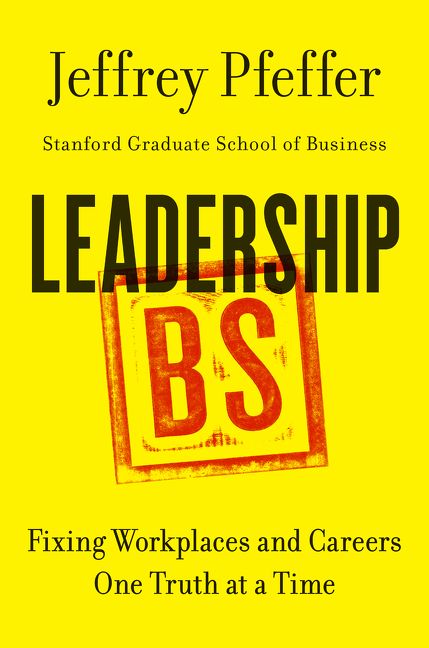
Leadership B.S. by Stanford University Professor Jeffrey Pfeffer (Book Review)
I highly recommend reading the excellent book Leadership BS: Fixing Workplaces and Careers One Truth at a Time by Professor Jeffrey Pfeffer of Stanford University. It was a finalist for the 2015 Financial Times and McKinsey Business Book of the Year and Best Business Book of the Week selected by Inc.com. This book will help you identify real and effective leadership and management lessons based on evidence that are more likely to work than platitudes.
Pfeffer’s approach is refreshingly honest about the realities of organizational life. He doesn’t offer easy answers or inspiring anecdotes. Instead, he provides research-based insights about how power actually works in organizations, how to build and maintain influence, and how to navigate the political realities that most leadership books ignore.
The book challenges many popular leadership myths with data and systematic observation. It shows why authentic leadership often fails, why humble leaders are often less effective than confident ones, and why focusing on employee happiness can sometimes undermine organizational performance. These aren’t comfortable truths, but they’re useful ones for anyone who wants to be effective rather than just well-liked.
Disclosure: In the acknowledgments section of this book, Professor Jeffrey Pfeffer writes:
This book was inspired in part by my interactions with Rajiv Pant. It was Rajiv who first used the phrase “feel-good leadership literature.” It was Rajiv who provided some of the stories and examples incorporated in this book. But mostly it was Rajiv Pant who helped me see how much damage was occurring because of the current incarnation of the leadership industry. Rajiv’s support and friendship mean a great deal, not only for this book but in my life.
Pfeffer, Jeffrey. Leadership BS: Fixing Workplaces and Careers One Truth at a Time (pp. 221-222). HarperCollins. Kindle Edition.
My rating of this book: 5/5 stars.