
This is a framework for understanding, describing, and actually performing your job in a way that creates real value. After years of watching talented people spin their wheels on busy work while critical objectives languish, I’ve developed this approach as an antidote to the conventional job description—that dusty document you looked at once during interviews and never again.
The framework divides any job into three fundamental categories: activities, outputs, and outcomes. Understanding the crucial differences between these—and more importantly, the dynamic relationships among them—can transform how you approach your work, regardless of whether you’re an individual contributor crafting code or a senior executive shaping strategy.
The Problem with Traditional Job Descriptions
Ask yourself this question: After being hired in a job, do you ever refer to your HR job description to guide you or to check if you are doing what your job is described as?
If you’re like most professionals, the answer is no. Traditional job descriptions are recruitment advertisements masquerading as operational documents. They’re designed to attract candidates, satisfy HR compliance requirements, and check legal boxes. But as practical guides for actual work? They’re about as useful as a car’s marketing brochure when you’re trying to fix the engine.
This framework offers something different: a living, breathing guide that you’ll actually reference and refine throughout your tenure. Think of it as the owner’s manual for your role—one that evolves as you and your organization grow. For those seeking even more comprehensive guidance, I’ve previously shared longer handbooks like my 90 Day Plan for a CTO in a New Job and How to be an effective CTO.
The Fundamental Truth About Results
You can’t magically drive results. This isn’t a motivational poster platitude—it’s a fundamental principle of organizational physics. To meet your company’s objectives and key results (OKRs), you must engage in purposeful activities that produce meaningful outputs. The magic happens when these three elements align, creating a virtuous cycle of value creation.
But here’s where most professionals stumble: they confuse motion with progress, deliverables with value, and metrics with meaning. Let’s untangle these concepts.
Activities: The Foundation of Your Work
Activities are the atomic units of your professional life—the things you spend time doing. They’re the meetings you attend, the emails you write, the conversations you have. But not all activities are created equal. Some serve as essential building blocks toward meaningful results, while others are merely organizational theater.
The key distinction lies in purposefulness. Before engaging in any activity, you should be able to articulate its connection to either an output or an outcome. If you can’t, you’re likely wasting precious time—yours and others’.
High-Value Activities
The most valuable activities in any role typically fall into several categories:
Building Relationships and Trust: Those seemingly casual coffee chats and hallway conversations aren’t just social niceties. They’re the foundation of organizational effectiveness. When you invest time in understanding your colleagues’ perspectives, challenges, and working styles, you’re creating the connective tissue that makes everything else possible. Trust is the lubricant of organizational machinery.
Knowledge Transfer and Development: Whether you’re mentoring a junior colleague, conducting a thoughtful code review, or facilitating a lessons-learned session, activities that spread knowledge multiply their value across the organization. The time you spend teaching someone today saves countless hours tomorrow—and builds the collective intelligence of your team.
Strategic Thinking and Planning: This includes not just formal planning sessions, but also the quiet moments of reflection where you step back from the tactical and consider the bigger picture. Are we solving the right problems? Are our efforts aligned with our ultimate goals? These activities often feel unproductive in the moment but yield outsized returns.
Conflict Resolution and Alignment: Organizations are complex systems with competing priorities and perspectives. Time spent resolving conflicts, aligning stakeholders, and building consensus isn’t overhead—it’s essential work that prevents costly missteps and rework.
The Activity Trap
Here’s where I see many professionals—especially conscientious ones—fall into a trap. They equate being busy with being valuable. When I ask someone how work is going and they breathlessly reply, “busy, very busy,” I hear a warning signal.
Unless you’re an emergency room physician or a soldier in active combat, chronic busyness typically indicates one of two problems: either you’ve lost control of your priorities, or your organization has fundamental issues with resource allocation. Neither reflects well on your professional effectiveness.
Consider this: A hamster on a wheel is incredibly busy, expending tremendous energy, yet it never moves forward. Similarly, you can fill every moment of your workday with activities—responding to every email within minutes, attending every meeting you’re invited to, helping everyone who asks—and still contribute little to your organization’s success.
Don’t be busy, be purposeful.
The most effective professionals I know aren’t the busiest. They’re the most deliberate. They understand that saying no to low-value activities creates space for high-impact work. They treat their time like a strategic resource, investing it where it will yield the greatest returns.
Outputs: Your Tangible Contributions
If activities are what you do, outputs are what you create. They’re the tangible manifestations of your work—the documents, code, designs, and analyses that others can see, use, and build upon. Outputs represent maker’s work in its purest form.
This distinction is crucial, especially for those in leadership roles. Your team’s outputs don’t automatically count as your own unless you had a significant hands-on role in their creation. Managing the process isn’t the same as creating the product. This isn’t about taking credit—it’s about maintaining the skills and credibility that come from staying close to the actual work.
The Lottery Test
Creating regular outputs serves another critical function: it helps you pass what I call the “lottery test”:
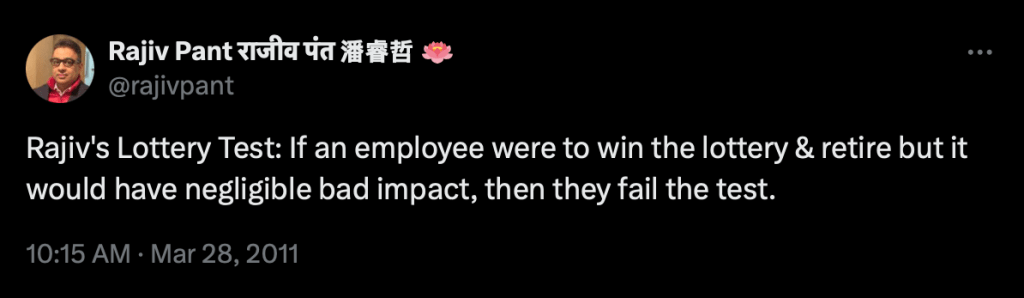
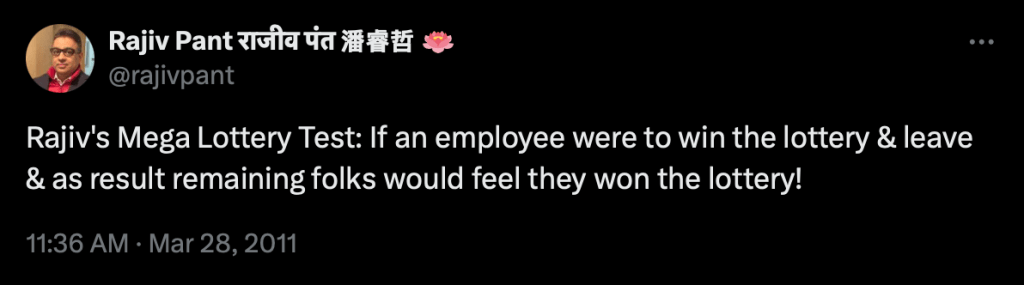
If you disappeared tomorrow, what evidence of your contributions would remain? Outputs create that evidence—a trail of tangible value that persists beyond your presence.
High-Quality Outputs
Not all outputs are equal. A hastily thrown-together slide deck is technically an output, but it may contribute little to organizational knowledge. High-quality outputs share several characteristics:
Clarity of Thought: The best outputs reflect deep thinking made accessible. They take complex ideas and present them in ways that others can understand and act upon. This is why writing is so powerful—it forces you to clarify your thinking.
Durability: Great outputs have staying power. They remain useful beyond the immediate moment, serving as references, templates, or foundations for future work. A well-crafted strategy document, a thoroughly commented codebase, or a comprehensive competitive analysis continues delivering value long after its creation.
Actionability: The most valuable outputs enable action. They don’t just describe problems—they propose solutions. They don’t just present data—they extract insights. They move the organization forward.
The Power of Writing
Amazon’s Jeff Bezos famously banned PowerPoint in favor of written narratives, and for good reason:
“The reason writing a ‘good’ four page memo is harder than ‘writing’ a 20-page PowerPoint is because the narrative structure of a good memo forces better thought and better understanding of what’s more important than what.”
Writing forces rigor. You can’t hide fuzzy thinking behind bullet points or distract with animations. When you write out your ideas in complete sentences and paragraphs, gaps in logic become obvious, assumptions get exposed, and the real work of thinking becomes unavoidable.
Collaborative Creation
While outputs must be substantially your own work to count as yours, the best outputs rarely emerge in isolation. Share early drafts. Seek feedback. Test your ideas against others’ perspectives. Stanford Professor Baba Shiv’s research on the Art of the Imperfect Pitch shows that exposing work-in-progress actually increases buy-in and improves outcomes.
Your colleagues should have visibility into what you’re creating and why. This transparency serves multiple purposes: it prevents duplication of effort, enables early course corrections, and builds organizational knowledge even before the output is complete.
Outcomes: The Ultimate Measure
Outcomes are where activities and outputs converge to create real value. They’re the measurable results that matter to your organization, your customers, and ultimately, your career. While activities keep you busy and outputs keep you productive, outcomes determine whether you’re actually effective.
The challenge with outcomes is that they’re often the result of collective effort. Rarely can one person claim sole credit for a significant business result. This is why the OKR framework has gained such traction—it acknowledges that meaningful outcomes require aligned effort across teams and functions.
Meaningful Metrics
Not everything that can be measured qualifies as a meaningful outcome. True outcomes share several characteristics:
Direct Business Impact: They clearly connect to organizational success. Revenue growth, customer satisfaction improvements, cost reductions, and market share gains are classic examples. But don’t overlook less obvious outcomes like improved employee retention or reduced time-to-market for new features.
Attributable Contribution: While outcomes often result from team effort, you should be able to articulate your specific contribution. What activities did you engage in? What outputs did you create? How did these lead to the outcome? This isn’t about claiming undue credit—it’s about understanding and communicating your value.
Sustainable Results: The best outcomes endure. A one-time spike in sales is less valuable than building a repeatable sales process. A temporary cost reduction is less impressive than a structural efficiency improvement. Focus on outcomes that create lasting value.
The Outcome Paradox
Here’s a paradox I’ve observed throughout my career: the more directly you chase outcomes, the less likely you are to achieve them. It’s like trying to fall asleep—the harder you try, the more elusive it becomes.
This happens because outcomes are lagging indicators. By the time you can measure them, the activities and outputs that created them are already complete. Focusing exclusively on outcomes is like driving while looking only in the rearview mirror.
The solution? Create a balanced portfolio across all three categories. Engage in purposeful activities, create high-quality outputs, and trust that meaningful outcomes will follow. Monitor outcomes to ensure you’re on track, but invest your daily energy in the activities and outputs that will eventually produce those results.
Putting It All Together: Your Personal Operating System
Understanding this framework is just the beginning. The real value comes from applying it to create your own personal operating system—a practical guide for navigating your specific role.
Step 1: Audit Your Current State
Start by examining how you currently spend your time. Track your activities for a week. What percentage of your time goes to each type of activity? How many tangible outputs do you create? Can you trace clear lines from your activities through your outputs to meaningful outcomes?
Most professionals discover they’re spending far too much time on low-value activities and creating fewer meaningful outputs than they thought. This isn’t a personal failing—it’s the natural result of organizational entropy. Without deliberate effort, all systems tend toward disorder.
Step 2: Design Your Ideal State
Working with your manager and key stakeholders, define what success looks like in your role:
- What outcomes are you responsible for driving?
- What outputs will most effectively lead to those outcomes?
- What activities will enable you to create those outputs?
This isn’t a one-time exercise. Your ideal state will evolve as your role grows and organizational priorities shift. The key is to maintain alignment between your daily work and your desired results.
Step 3: Create Your Operating Manual
Document your framework in a format you’ll actually use. This could be:
- A one-page visual diagram showing the connections between your activities, outputs, and outcomes
- A quarterly checklist ensuring you’re maintaining balance across all three categories
- A template for weekly planning that explicitly considers all three elements
The format matters less than the discipline of regular review and refinement.
Step 4: Iterate and Improve
Schedule regular reviews—monthly at first, then quarterly once you’ve established rhythm. Ask yourself:
- Are my activities leading to the outputs I intended?
- Are my outputs contributing to the outcomes I’m accountable for?
- What’s working well? What needs adjustment?
- How has my role evolved, and how should my framework adapt?
This iterative approach transforms your job from a static set of responsibilities into a dynamic system for creating value.
Alternative Approaches and Future Directions
While I’ve found this framework highly effective, it’s not the only approach to role definition. Holacracy, for instance, uses a different trio: purpose, accountabilities, and domains.
The Holacracy model offers valuable insights, particularly around clarity of authority and decision rights. I’m exploring ways to incorporate these concepts into future iterations of this framework, potentially adding a fourth element around “authorities” or “decision rights” to complement activities, outputs, and outcomes.
The Compound Effect
The real power of this framework emerges over time. When you consistently engage in high-value activities that produce meaningful outputs leading to significant outcomes, you create a compound effect. Your skills deepen. Your reputation grows. Your impact multiplies.
More importantly, you avoid the trap that ensnares so many talented professionals: the illusion of productivity without progress. By maintaining clarity about the distinctions and connections between activities, outputs, and outcomes, you ensure that your considerable efforts translate into real results.
A Living Document for a Dynamic World
Unlike traditional job descriptions that gather dust from day one, this framework creates a living document that evolves with you. It’s simultaneously a planning tool, an execution guide, and a reflection prompt. It helps you navigate the daily chaos of organizational life while maintaining sight of your ultimate objectives.
In a world where the half-life of specific skills continues to shrink and roles shape-shift with increasing frequency, this framework provides stability without rigidity. It’s specific enough to guide daily decisions yet flexible enough to accommodate change.
Your Next Steps
If this framework resonates with you, I encourage you to begin applying it immediately. Start small—perhaps with a simple audit of this week’s activities. Or draft a list of your recent outputs and trace their connection to organizational outcomes.
Share your experiences. If you create your own version of this framework, I’d love to see it. Tweet your insights to @rajivpant, and I’ll share the best examples with our broader community.
Remember: the goal isn’t perfection. It’s progress. Every step toward greater clarity about your activities, outputs, and outcomes is a step toward more meaningful and impactful work.
Because ultimately, that’s what we all want: to know that our efforts matter, that our contributions create value, and that our work moves our organizations—and ourselves—forward. This framework is simply a tool to help make that aspiration a reality.
For those ready to dive deeper, consider creating a comprehensive handbook for your role, complete with checklists that enhance consistency and quality. My CTO 90 Day Plan serves as one such example.
The investment you make in clarifying and documenting your approach to your role pays dividends not just for you, but for your successors. When you eventually move on to your next challenge, you’ll leave behind more than just memories—you’ll leave a roadmap for continued success.
Further Reading
2023 December Update: In light of my recent exploration in the blog post ‘Beyond Outcomes: Why Great Leaders Prioritize Inputs‘, it becomes clear how the framework of activities, outputs, and outcomes fits into an even broader context of leadership and management philosophy. While my 2018 article above breaks down the workflow into tangible segments, my newer article delves into the foundational elements that precede these segments – the inputs. These inputs encompass the actions, decisions, and values that ultimately drive the activities, shape the outputs, and determine the outcomes. By understanding and prioritizing these inputs, as discussed in the new post, leaders can enhance their approach to each stage of the framework established here. The insights from ‘Beyond Outcomes‘ provide an additional layer of depth to the concepts discussed in this post, offering readers a more rounded perspective on effective leadership. I invite you to read the new post here for a deeper dive into how great leadership is nurtured at its very core.