Last week, I watched an AI agent debug a production issue, write a fix, create comprehensive tests, and deploy the solution—all while the product and tech leader was hanging out with the team discussing product strategy. The entire process took twelve minutes. Two years ago, this would have consumed days of engineering and product effort. Welcome to the new reality of technology and product leadership.
Nearly a decade ago, I wrote a 90-day plan for CTOs starting new roles. That framework focused on understanding organizations, building teams, and implementing processes—fundamentally human activities in a human-centered technology world. Today, as generative AI reshapes not just how we build but what it means to build, we need an entirely new playbook.
After leading technology and product at organizations including The New York Times, The Wall Street Journal, Hearst, Condé Nast, and Reddit, I’ve witnessed firsthand how AI/ML and now generative AI is fundamentally rewiring the technology and product leadership roles.
Now, as I work with my colleagues Kirim and Sezer to reinvent Flatiron Software and develop Snapshot AI for the AI era, the changes ahead will dwarf even the mobile and cloud transformations we’ve navigated over the past two decades.
The Great Inversion of Coding: When Machines Code and Humans Orchestrate
The traditional CTO role centered on translating business needs into technical architecture. I hired engineers, organized teams, selected technologies, and managed delivery. The CPO role focused on understanding users, defining features, and prioritizing backlogs. Both roles assumed a fundamental constraint: human coding capacity. That constraint is evaporating.
Both CTO and CPO roles assumed a fundamental constraint: human coding capacity.
That constraint is evaporating.
In 2025, we’re witnessing what I call “The Great Inversion of Coding” — the shift from humans writing code that machines execute to humans defining intent that machines implement. This isn’t just about GitHub Copilot or ChatGPT helping with boilerplate code. We’re approaching a threshold where AI agents can own entire subsystems, from conception through maintenance. AI can work with existing code, not just write new code.
“Every architecture review will soon start with a new question,” Kirim observes. “Which parts were written by people, which by AI—and do we trust both?”
Consider what this means: When an AI agent can transform a product requirement into production code faster than you can explain it to a human engineer, the entire value chain of software creation shifts. The question isn’t whether this will happen—it’s how we adapt our leadership to thrive in this reality.
The New CTO: Conductor of Human-AI Symphonies
Today’s CTO must evolve from chief builder to chief orchestrator. Think of it as moving from architect to urban planner—you’re no longer designing individual buildings but entire ecosystems where human creativity and AI capability interweave.
What Changes:
Instead of managing coders, you’re curating capabilities. Each AI agent brings specific strengths—one might excel at refactoring legacy code, another at generating test suites, yet another at optimizing database queries. Your job becomes orchestrating these capabilities alongside human judgment, creativity, and domain expertise.
Traditional technical debt meant code that was hard to change. In the AI era, you’re managing model drift, capability degradation, and the compounding effects of AI-generated code that no human fully understands. This requires new metrics, monitoring approaches, and intervention strategies.
Choosing between AWS and Azure matters less than designing how Claude, GPT-4, Gemini, and specialized models interact within your architecture. You’re building AI supply chains where different models handle different aspects of development, each with its own strengths, costs, and constraints.
What Remains Fundamentally Human:
While AI excels at pattern matching and implementation, connecting disparate business contexts to technology possibilities remains uniquely human. An AI can optimize a recommendation engine, but understanding why personalization might conflict with editorial values in a media company requires human judgment.
Building trust with boards, partnering with other executives, and inspiring teams transcends logic into emotion, politics, and persuasion. AI can draft the perfect technical memo, but it can’t read the room when the CEO’s real concern isn’t technical feasibility but market perception.
As AI capabilities expand, CTOs become ethics officers by default. Deciding what we should build, not just what we can build, requires human values, cultural understanding, and moral courage that no model can replicate.
The Evolved CPO: From Feature Factory to Experience Architect
The Chief Product Officer role faces even more dramatic transformation. When AI can generate features faster than users can adopt them, the entire discipline of product management must reinvent itself.
The Shift in Product Thinking:
In a world where any feature can be rapidly replicated by competitors using similar AI tools, sustainable differentiation comes from holistic experiences that blend functionality with emotion, community, and purpose. The CPO becomes less a feature prioritizer and more an experience philosopher.
Large language models trained on human interaction data can predict user needs with uncanny accuracy. But they can’t determine whether fulfilling those needs aligns with your product’s purpose or your company’s values. The CPO must balance what users want, what AI predicts they’ll want, and what’s actually good for them.
Traditional roadmaps assumed scarce engineering resources and sequential delivery. When AI can parallelize development, the constraint shifts from building to choosing. CPOs must curate portfolios of capabilities, knowing that implementation speed no longer gates innovation.
The New Product Superpowers:
As creation becomes commoditized, curation becomes crucial. Like a museum curator who creates meaning through selection and arrangement, CPOs must develop exquisite taste for what deserves to exist in their products.
Products need stories that resonate beyond functionality. The CPO crafts narratives that give users identity, community, and purpose—elements that transcend algorithmic optimization.
With AI enabling rapid feature proliferation, maintaining conceptual integrity becomes harder and more valuable. The CPO guards against feature sprawl by ensuring every capability reinforces the core product narrative.
The Transformation of Engineering and Product Organizations
The boundaries between product and engineering, already blurring, will likely dissolve entirely in many organizations. But not in the way most predict.
The Death and Rebirth of Traditional Roles
What’s Dying:
Engineers who primarily translate specifications into code become redundant when AI handles implementation. The “code monkey” stereotype, always unfair, becomes literally obsolete. Product managers who excel at writing detailed requirements and managing backlogs lose relevance when AI can generate and implement features from high-level intent. System architects who design in isolation become anachronisms when AI can explore solution spaces faster than humans can document them.
What’s Emerging:
New roles are evolving that combine technical skills with creative problem-solving. AI Whisperers excel at crafting prompts, fine-tuning models, and extracting maximum capability from AI systems. They understand not just what AI can do, but how to make it do what’s needed elegantly.
Experience Architects focus on holistic user journeys rather than individual features. They think in systems, emotions, and narratives rather than user stories and acceptance criteria. Quality Guardians verify AI output against nuanced criteria—not just functional correctness but elegance, maintainability, security, and alignment with organizational values. Capability Composers orchestrate portfolios of human and AI capabilities, understanding how to combine them for maximum impact.
The New Career Lattice
Traditional career ladders assume linear skill progression in stable disciplines. The AI era demands career lattices that support lateral movement and continuous reinvention.
The traditional engineering path of Junior to Senior to Staff to Principal Engineer gives way to a more fluid structure. Implementation Engineers might move laterally to become AI Integration Specialists, then shift to System Orchestrators or Quality Architects. Each transition brings new perspectives and skills rather than just deeper expertise in a narrow domain.
Similarly, the product career transforms from a linear progression through PM ranks to a network of interconnected roles. Experience Designers might transition to Capability Curators, then to AI Product Strategists or Community Builders. These lattices encourage professionals to gather diverse capabilities rather than deepening narrow expertise.
Organizational Structures for the AI Age
Traditional functional silos made sense when building was the constraint. When AI accelerates building by orders of magnitude, organizations must restructure around different principles.
Instead of engineering and product departments, leading organizations are forming interdisciplinary studios focused on specific user outcomes. Each studio combines human insight generators, AI capability orchestrators, experience architects, quality guardians, and domain experts working in concert.
Command-and-control structures break down when AI can surface insights from anywhere in the organization. Network structures that enable rapid reconfiguration around opportunities become essential. Think Hollywood production models—temporary assemblies of specialized talent—rather than corporate hierarchies.
Measuring teams by number of humans becomes meaningless when one engineer with sophisticated AI tools out-produces entire traditional teams. Organizations must develop new metrics around capability coverage, adaptation velocity, innovation throughput, and quality consistency.
The Human Edge: Skills That Become More Valuable
As AI handles increasing technical complexity, distinctly human capabilities become paradoxically more valuable. The skills that matter in 2025 and beyond cluster around judgment, synthesis, and connection.
Critical Thinking in the Age of Hallucination
Large language models generate plausible-sounding content regardless of accuracy. This makes critical evaluation skills essential. Tomorrow’s technology leaders must develop AI forensics capabilities, understanding how different models fail and recognizing hallucination patterns in generated code and content.
Mastering prompt engineering becomes a form of strategic thinking. Leaders must craft prompts that elicit nuanced, contextual responses, chain prompts to build complex reasoning sequences, and understand how tokenization, attention mechanisms, and training data influence outputs.
Navigating uncertainty requires wisdom to distinguish between AI confidence and actual reliability, knowing when to trust automated systems versus requiring human oversight, and building decision frameworks that appropriately weight AI input.
Sidebar: I recently wrote Why Prompt Engineering Is Legitimate Engineering: A Case for the Skeptics which generated a fair amount of debate on Reddit and other platforms.
Synthesis: The Ultimate Differentiator
While AI excels at pattern matching within domains, connecting insights across disparate fields remains distinctly human. Leaders who synthesize effectively will drive disproportionate value.
Cross-domain pattern recognition becomes crucial—connecting technical possibilities to business opportunities, identifying how solutions in one industry apply to another, and recognizing when AI breakthroughs enable new product categories.
Temporal synthesis requires understanding historical patterns while imagining novel futures, balancing learning from data with envisioning possibilities, and navigating the tension between AI’s statistical nature and innovation’s need for deviation.
Cultural translation involves bridging technical and business languages fluently, translating between AI capabilities and human needs, and navigating global differences in AI adoption and acceptance.
Emotional Intelligence in Human-AI Teams
As teams become hybrid human-AI entities, emotional intelligence evolves from nice-to-have to mission-critical. Leaders must recognize when team members feel threatened by AI capabilities, build cultures that celebrate human-AI collaboration over competition, and address the psychological impact of rapid capability shifts.
Understanding stakeholder psychology becomes essential—addressing executive fears about AI replacing human judgment, navigating board concerns about AI risks and liability, and managing employee anxiety about career relevance.
Maintaining customer empathy in the AI age means recognizing when AI-generated experiences feel hollow or manipulative, understanding the human need for authentic connection, and balancing efficiency gains with relationship building.
For CTOs and CPOs alike, understanding and working with the “API” of fellow human beings becomes even more important in the age of AI.
Deep Dive: Human Roles, AI Roles, Hybrid Roles
Understanding the theoretical framework is one thing—implementing it is another. The most challenging aspect of leading human-AI teams lies in making daily decisions about which tasks should remain human-only, which can be fully automated, and which benefit from hybrid approaches. This delegation matrix becomes your operational playbook, helping you maximize both human potential and AI capability while avoiding the common pitfalls of over-automating creative work or under-utilizing AI for routine tasks. Expand the section below for a comprehensive framework and specific examples you can apply immediately.
Deep Dive: Work Delegation: The Human-AI Partnership Matrix
Work Delegation: The Human-AI Partnership Matrix
The question isn’t what AI will replace but how humans and AI can amplify each other. Here’s a framework for thinking about work delegation in the AI age:
Delegate to AI: Predictable Pattern Work
AI excels at tasks with clear patterns and defined outcomes. This includes boilerplate code creation, legacy system modernization, test suite generation, documentation creation, and code review for standard patterns. For data processing and analysis, AI handles log analysis and anomaly detection, performance optimization, A/B test analysis, user behavior pattern recognition, and competitive intelligence gathering. Content creation at scale becomes manageable through AI-generated API documentation, error messages and user notifications, marketing copy variations, localization and translation, and SEO optimization.
Reserve for Humans: Judgment and Connection
Certain activities require distinctly human capabilities. Strategic decision making includes architecture decisions with long-term implications, build vs buy vs partner evaluations, technical strategy aligned with business goals, risk assessment for novel approaches, and ethical implications of technical choices. Creative problem solving encompasses novel algorithm design, user experience innovations, system architecture for unprecedented scale, crisis response and incident command, and cross-functional challenge resolution. Relationship building remains fundamentally human through team inspiration and motivation, stakeholder alignment and buy-in, customer empathy and insight, partner negotiations, and culture development.
The Hybrid Zone: Human-Guided AI Work
The most interesting category combines human judgment with AI capability. In AI-assisted architecture, humans define constraints and goals while AI generates multiple architecture options. Humans evaluate trade-offs, AI implements the chosen approach, and humans monitor and adjust. Collaborative product development starts with humans identifying user needs, followed by AI generating feature concepts. Humans curate and refine these concepts, AI builds prototypes, humans test with users, and AI iterates based on feedback. Augmented decision making involves AI surfacing data and patterns, humans providing context and values, AI modeling scenarios, humans making final decisions, and AI implementing and monitoring outcomes.
The Media Industry’s AI Evolution
The media industry represents ground zero for AI disruption because it touches every aspect of the business simultaneously—content creation, distribution, personalization, and monetization all face AI transformation at once. Unlike industries where AI adoption can be gradual and departmental, media companies must reinvent their entire value proposition while maintaining daily operations. The strategies emerging from this high-pressure environment reveal patterns that leaders across industries can adapt before facing similar pressures in their own sectors. Follow this link to explore specific strategies and real-world examples from major media transformations.
The Future of Engineering Services
My current work with Flatiron Software and Snapshot AI reveals entirely new paradigms for how engineering services are delivered and measured. When AI can write code faster than humans can review it, traditional metrics like lines of code or story points become meaningless. The companies pioneering this space are developing new frameworks for productivity measurement, quality assurance, and client engagement that will likely define the next decade of technology services. These early experiments reveal patterns that every technology leader needs to understand. Follow this link for detailed insights into new measurement frameworks and implementation strategies.
Deep Dive: Technical Foundation for AI Leadership
Strategy without technical foundation crumbles under real-world pressure. While leadership frameworks help you think about human-AI collaboration, you also need concrete architectural principles that guide your technical decisions when AI capabilities evolve faster than your planning cycles. The challenge isn’t predicting which specific AI models will dominate, but building systems flexible enough to adapt as capabilities emerge and change. This requires rethinking fundamental assumptions about deterministic systems, predictable outputs, and human-controlled processes. Expand the section below for battle-tested principles that will keep your architecture resilient regardless of which AI breakthrough comes next.
Deep Dive: Building for the Unknown: Architectural Principles for AI-First Organizations
Building for the Unknown: Architectural Principles for AI-First Organizations
The pace of AI advancement makes specific technical predictions futile. Instead, we need architectural principles that remain valid regardless of which models dominate or what capabilities emerge.
Principle 1: Design for Composability
Build systems as collections of independent, interchangeable components. Avoid tight coupling to specific AI models, create abstraction layers for AI capabilities, enable easy swapping of AI providers, and design interfaces that accommodate capability evolution.
Principle 2: Embrace Probabilistic Systems
Traditional software is deterministic—same input, same output. AI systems are probabilistic, requiring new approaches. Build confidence scoring into all AI-generated outputs, design fallback paths for low-confidence results, create feedback loops for continuous improvement, and accept that perfection is impossible while aiming for resilience.
Principle 3: Instrument for Observability
When AI makes decisions inside black boxes, observability becomes critical. Log all AI interactions and decisions, build explainability into user interfaces, create audit trails for compliance and debugging, and monitor for drift and degradation.
Principle 4: Design for Continuous Learning
Static systems die in the AI age. Build learning into architecture by capturing user feedback on AI outputs, enabling rapid model updates and testing, creating sandboxes for capability experimentation, and designing for graceful capability evolution.
Principle 5: Prioritize Human Agency
As AI capabilities expand, preserving human control becomes ethical and practical necessity. Always provide human override capabilities, make AI decision-making transparent, enable users to choose their AI involvement level, and design for human dignity and purpose.
The Leadership Imperatives: What CTOs and CPOs Must Do Now
The future arrives gradually, then suddenly. Here’s what technology leaders must do today to prepare for tomorrow:
1. Build AI Literacy Throughout Your Organization
Don’t let AI knowledge concentrate in a few experts. Democratize understanding by running hands-on workshops where everyone uses AI tools, creating internal prompt engineering competitions, sharing AI success and failure stories openly, and encouraging experimentation with personal projects.
2. Redesign Your Hiring and Development Programs
Traditional hiring focuses on current skills. AI-era hiring must emphasize learning agility. Test for adaptability, not just expertise. Hire for judgment and taste, not just technical skill. Create apprenticeship programs that pair humans with AI and design career paths that encourage breadth.
3. Experiment with Radical Organizational Models
Small, bold experiments today inform tomorrow’s transformation. Create an AI-augmented tiger team for a specific project, try outcome-based budgeting instead of headcount, run a “studio model” pilot for one product area, and measure value delivery, not activity.
4. Develop Your AI Ethics Framework
Ethics can’t be an afterthought when AI moves at machine speed. Define clear principles for AI use in your organization, create review processes for AI-generated decisions, build diverse teams to identify blind spots, and engage with stakeholders on AI concerns.
5. Cultivate Strategic Patience with Tactical Urgency
The AI transformation will take longer than enthusiasts predict but move faster than skeptics believe. Make long-term bets on capability building while running rapid experiments to learn quickly. Avoid both AI FOMO and AI denial, and build resilience for multiple scenarios.
The Call to Adventure: Leading in Unprecedented Times
We stand at an inflection point as significant as the dawn of computing itself. The leaders who thrive won’t be those who resist change or blindly embrace it, but those who thoughtfully navigate the transformation.
The CTO role evolves from chief builder to chief orchestrator, conducting symphonies of human creativity and machine capability. The CPO role transforms from feature definer to experience philosopher, crafting meaning in an age of infinite possibility. Both must become bridge builders—between human and artificial intelligence, between present reality and future potential, between what we can build and what we should build.
This isn’t about replacing humans with machines. It’s about augmenting human judgment with machine capability, amplifying human creativity with machine productivity, and extending human impact with machine scale. The organizations that flourish will be those that master this synthesis. Working with Sezer and Kirim on organizational transformation has shown me how founder-level goal reviews on every engagement create the accountability structures needed for this human-AI synthesis to succeed.
As I learned during my years in media and throughout my work as a senior advisor to companies like You.com and ScalePost AI since their founding, the most profound transformations happen not when new technology arrives, but when we reimagine what’s possible. The printing press didn’t just speed up book copying—it democratized knowledge. The internet didn’t just connect computers—it connected humanity. Generative AI won’t just automate coding—it will reimagine how we create, collaborate, and compete.
The playbook I’m sharing isn’t complete—it can’t be, given the pace of change. But it provides a foundation for thinking about leadership in the AI age. Your job is to take these principles, test them against your reality, and evolve them for your context.
Ten years from now, we’ll look back at 2025 as the year everything changed. The question isn’t whether you’ll be part of this transformation—you will be, whether you choose it or not. The question is whether you’ll help lead it.
The future of technology leadership isn’t about choosing between humans or AI. It’s about orchestrating their collaboration to create something neither could achieve alone. That’s our challenge, our opportunity, and our responsibility.
Welcome to the most exciting era in technology leadership history. The stage is set, the instruments are tuned, and the audience awaits. It’s time to conduct.
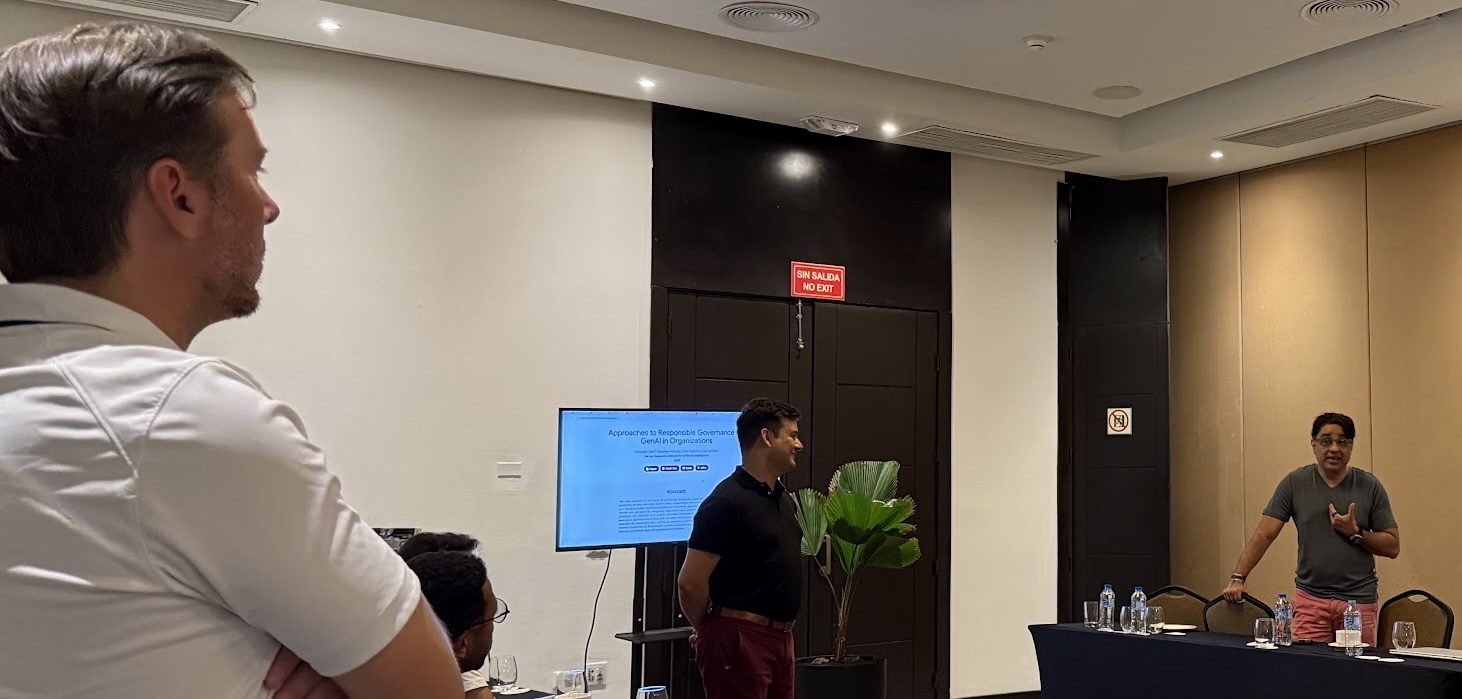
Many of these ideas were road-tested during our executive summit in Punta Cana last month, where a dozen CTOs and CPOs pressure-checked the framework with us. With Kirim steering every discussion back to customer value and Sezer translating the resulting priorities into a buildable plan, the room left convinced that tight loops between vision and execution are the real unlock in the AI era.


Flatiron × Snapshot Executive Summit | Punta Cana · May 2025 Strategy took center stage thanks to Kirim and Sezer, who framed the vision, and to Hanike, Ana Clara, and Ana Laura, who turned that vision into a seamless three-day agenda. Their combined super-powers shaped the leadership playbook explored above.
Thank you for reading this guide to technology leadership in the age of generative AI. I welcome your thoughts, challenges, and additions as we collectively navigate this transformation. Please share your experiences—we’re all learning together.
For more insights on AI and technology leadership, visit rajiv.com or connect with me on LinkedIn.
If you’re interested in how Flatiron Software and Snapshot AI are developing and implementing new models for engineering services and productivity measurement, I’d love to hear from you.