There are many good ways to organize your technology department. This article presents some of them. It is written for a CTO or VP Technology leading a medium size department looking for suggestions on organizing or reorganizing your Digital (Web, Mobile) technology department. It is best suited for you if your organization has the following characteristics:
- You manage software engineering, implementation and technology operations for 3 or more digital brands.
- Yours is a medium size technology department with somewhere between 20 to 100 technology staff.
- Internal corporate IT functions such as desktop support, telecommunications services and internal business systems are beyond the scope of this article.
The Venn diagram below presents one model of organizing your department into 3 sub-departments.
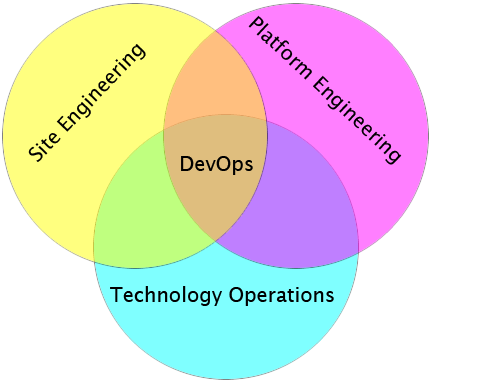 Web Technology Department Organization Venn Diagram Illustrating Purposeful Overlap Among Sub-Departments
Some CTOs in smaller companies organize their technology departments as 2 sub-departments: Software Engineering and Technology Operations. Software engineering is the function that is responsible for developing and implementing Web & Mobile application software. Technology Operations is responsible for running, maintaining and supporting the Web applications.
If you operate 1 or 2 digital brands (Web sites), having these 2 sub-departments is a good approach. For 3 or more Web sites, organizing Software Engineering into Site Engineering and Platform Engineering has some benefits.
Site Engineering
Site Engineering is focused on working on the Web sites’ direct projects. Each site engineering team is dedicated to one or two specific brands and develops an intimate understanding of that brand’s audience, content, and business model. Their work includes:
- Small and large projects for adding or changing functionality on the Web sites
- Bug fixes on the Web site applications
- Working closely with editorial, advertising, and business stakeholders who are specific to their brand
- Understanding the unique technical requirements of their sites (traffic patterns, content types, monetization models)
The benefit of dedicated site engineering teams is responsiveness. When an editor needs a feature for tomorrow’s election coverage, or an advertising team needs a new ad format by next week, the site engineering team can move quickly because they already understand the context. They do not need to be brought up to speed on the brand’s priorities.
Platform Engineering
Platform Engineering is typically smaller than the other two organizations and focuses on what is shared across all sites. A good platform team prevents each site team from reinventing the wheel. Their work includes:
- Architecture across sites
- Shared applications across sites (content management systems, ad servers, search, authentication)
- Common libraries across sites (APIs, SDKs, shared UI components)
- Research & Development (R&D)
- Integration between systems that serve multiple brands
- Performance optimization and scalability work that benefits all sites
The platform team’s success is measured by how much faster the site teams can ship because of the platforms and tools the platform team provides. If site teams are routinely building custom versions of things that should be shared, the platform team is not doing its job well enough.
Technology Operations
Technology Operations keeps everything running in production. In a media company with live audiences, downtime is not an abstract concern — it means readers cannot access news, advertisers do not get their impressions, and revenue stops. Operations work includes:
- Systems & Applications Administration
- Infrastructure Management (servers, networks, storage, cloud services)
- 24x7 Tech Support and incident response
- Builds & Configuration Management
- Release Management (deploying code to production safely)
- Testing & Quality Assurance (QA)1
- Technical Analysis
- Technical Project Management
- Budget Management
Purposeful Overlap
These three departments have purposeful overlap of responsibilities as illustrated in the Venn diagram above. That helps minimize the chances of the departments becoming silos with walls between them. For success, it is important that your entire department functions as one integrated unit. Some shared goals & responsibilities are required for mutual success.
For example, a site engineer who deploys code should understand how that code behaves in production, and an operations engineer who manages servers should understand what the applications running on them are trying to do. When these teams understand each other’s work, problems get solved faster and fewer things fall between the cracks.
DevOps
DevOps2 is a set of processes, methods and systems for communication, collaboration and integration between departments for Development (Applications/Software Engineering) and Technology Operations. Its purpose is to facilitate meeting business goals by producing good quality software products and services in a timely fashion. It is where development methodologies (such as agile software development) occur in an organization with separate departments for Development, Technology Operations and Quality Assurance. Development and deployment activities that need deep cross-departmental integration with Technology Support or QA require intimate multi-departmental collaboration.3
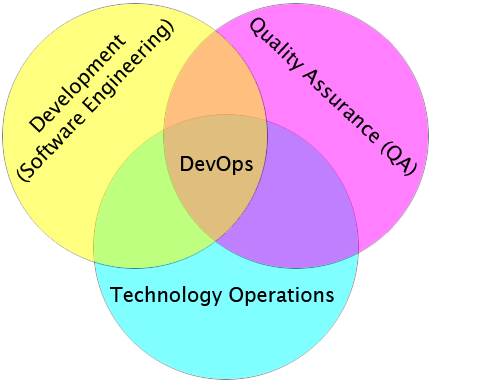 Illustration showing DevOps as the intersection of Development (Software Engineering), Technology Operations and Quality Assurance (QA)
Making It Work: The Three Directors
To make this work, you need 3 directors who head up these departments who work well together, collaborate often and are not sensitive about their turf. They should know that a successful technology manager is not an individual-only contributor, but a great team player with peers. They should have strong goodwill among each other and welcome each other to work directly with their teams.
This collaborative dynamic does not happen by accident. As CTO, you need to set the expectation explicitly, model it yourself, and reinforce it in how you run your leadership meetings. When the three directors are in a room together, they should be solving problems jointly, not defending their departments. If you see turf behavior, address it immediately — it will spread to their teams if left unchecked.
A practical way to foster this: have the three directors present their team’s work to each other regularly, share their roadmaps, and jointly own the metrics that matter to the business. When site engineering’s shipping speed depends on operations’ deployment pipeline, and operations’ reliability depends on platform engineering’s architecture, they are naturally incentivized to collaborate.
Article Updated: September 25, 2010
Updated: For larger technology departments (50-250 people), see the expanded version: Organizing a Digital Technology Department by Functional Areas. For how to structure career growth within these departments, see the management and technical career growth tracks.
Footnotes
-
QA can also be set up as an independent department. ↩